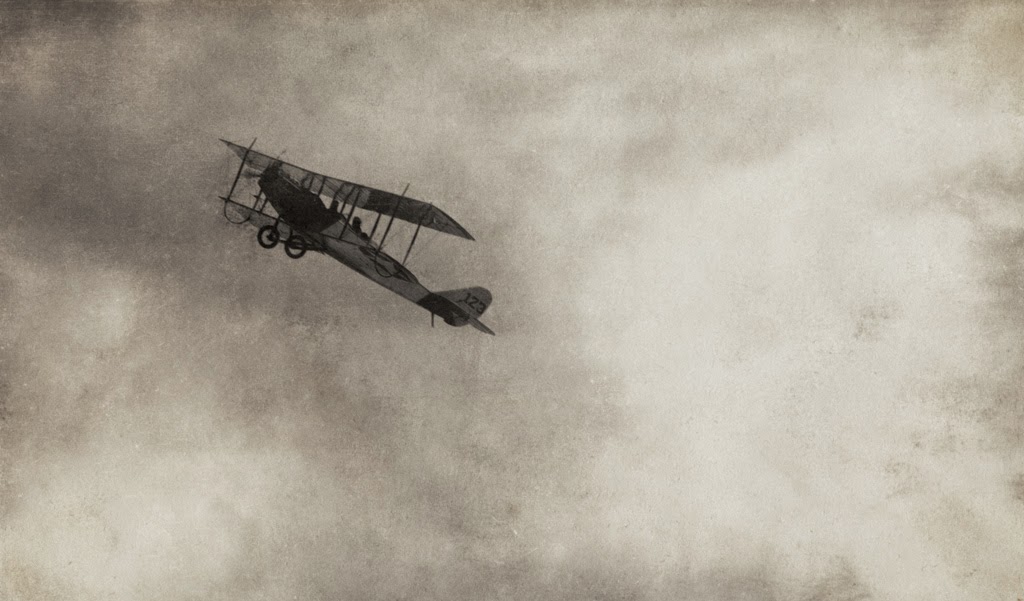
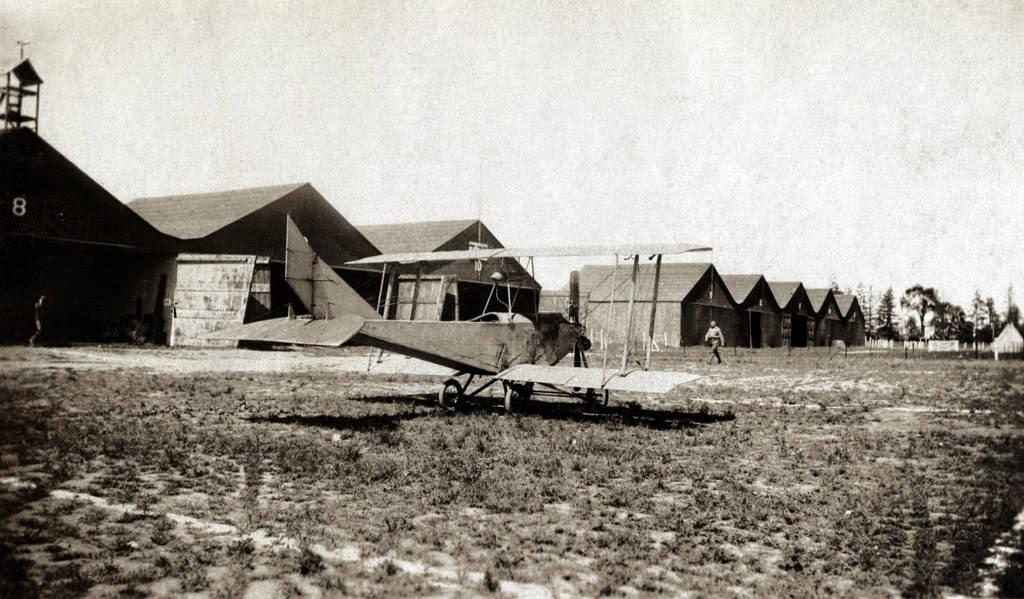
By this time Ivan had seen more than a handful of aviation deaths. He noted the passing of an individual in his scrapbooks with a star and there are many of them. These next photos document a very different kind of funeral in which Ivan participated.
Ivan dedicated three full pages in his scrapbooks to the death of fellow instructor Peter Carl "Tex" Millman. There are five magazine and newspaper clippings carefully laid out surrounding photos of the flight preparations. This "aerial funeral" is purported to have been the first of its kind.
Ivan was in his early seventies when he added his notes in ball point pen to the photographs. I recall seeing these scrapbooks laid out on tables in his bedroom in Long Beach, California and thinking it would be neat to look through them one day.
As I've done in the past I'll simply let the newspaper article tell the story:
In case it's not legible Ivan has written "Plane I Flew" on this photo.
This last magazine clipping is taken from Flying volume 5-6
I found the following quote regarding Mr. Millman (from Aerial Age volume 5) particularly poignant. ""Tex" was a good pilot. Although he had never won fame for any death-defying feats of the air, he was known as being as steady and intelligent a pilot as this country possesses...Yet with all this experience..."Tex" never had and accident, - never broke a stick. And it was not an airman's death that Peter Carl Millman died, for it was pneumonia that took him off..."
kpw
4/19/2015
4/05/2015
Joy of flight
Here is a group of photos all from one page of the scrapbook of Jennys in flight. I particularly like the clouds in these photos since most of Ivan's photos show very little details in the sky. For me, they capture the feeling of a day at the airfield with plenty of activity and the wonderful sound of ancient engines sputtering by.
I thought it would be fun to give a pilot's perspective of what it was like to fly the Jenny as an accompaniment to these photos, but they are harder to locate that I had imagined. The little I did find indicated that these first planes climbed very slowly (around 200 feet per minute), and needed plenty of rudder leading into turns due to adverse yaw. I found an excellent film of a pair of Jennys doing mock combat, which featured some steep turns and loops.
Stalls, steep turns, loops, and spins were all a part of Ivan's flight training and are plentiful in his logbooks. I recall him telling me his favorite aircraft was the Nieuport 28 due to it's ability to roll. I'll have to recheck the logbooks for rolls in the Jenny.
I thought it would be fun to give a pilot's perspective of what it was like to fly the Jenny as an accompaniment to these photos, but they are harder to locate that I had imagined. The little I did find indicated that these first planes climbed very slowly (around 200 feet per minute), and needed plenty of rudder leading into turns due to adverse yaw. I found an excellent film of a pair of Jennys doing mock combat, which featured some steep turns and loops.
Stalls, steep turns, loops, and spins were all a part of Ivan's flight training and are plentiful in his logbooks. I recall him telling me his favorite aircraft was the Nieuport 28 due to it's ability to roll. I'll have to recheck the logbooks for rolls in the Jenny.
3/29/2015
Safety first... or second.
Actually this isn't much about safety, but about equipment other than aircraft at Mineola. Ivan kept photographs of all kinds of things which were interesting or significant about his life, and his letters indicate that he kept these scrapbooks on the fly (sorry, I did it again). There isn't really much to say about these photos from my perspective other than the above except the first photo below.
I had the good fortune of working for Lance Neibauer soon after moving to Bend, Oregon. Lance started a company called Lancair around a handful of kitplanes and later came out with a certified version. Lance sold the company which would become Columbia, where I worked on the flight line, calibrating systems and making sure the aircraft were kept in a flight-worthy condition during flight testing for conformity.
Engine calibration was a big part of our job, so this photograph resonates with me pretty deeply. I have to laugh when I see the fuel tanks sitting right under a set of transformers, though. I feel happy that I have this in common with Ivan; we were both aircraft mechanics!
Ivan's biography notes that he did early testing in bombing and night-flying. I assume this bank of lights is in the collection for this reason. The other item behind the lights is a larger spot light covered up, probably for the snow.
I'm including the next two since Ivan was an automobile nut, and who can resist an early model Harley Davidson? Teddy Lyons is credited as the rider.
Much more to come!
kpw
I had the good fortune of working for Lance Neibauer soon after moving to Bend, Oregon. Lance started a company called Lancair around a handful of kitplanes and later came out with a certified version. Lance sold the company which would become Columbia, where I worked on the flight line, calibrating systems and making sure the aircraft were kept in a flight-worthy condition during flight testing for conformity.
Engine calibration was a big part of our job, so this photograph resonates with me pretty deeply. I have to laugh when I see the fuel tanks sitting right under a set of transformers, though. I feel happy that I have this in common with Ivan; we were both aircraft mechanics!
Ivan's biography notes that he did early testing in bombing and night-flying. I assume this bank of lights is in the collection for this reason. The other item behind the lights is a larger spot light covered up, probably for the snow.
I'm including the next two since Ivan was an automobile nut, and who can resist an early model Harley Davidson? Teddy Lyons is credited as the rider.
Much more to come!
kpw
3/22/2015
Taxi Trainer?
I landed on (sorry) two obscure photos this week. Like the two photos on the 'hazing' recently, these photos are so different that they force me to look into them. There are literally hundreds of photos of Jennys, dozens of F-boats and over 300 of the Indy 500. But these two also tell a story, and one that I will probably revisit.
First, a close shot of two gentlemen, one in the cockpit. One person in the cockpit is significant. All of these trainers had two cockpits, a forward cockpit for the student, and the aft for the instructor. Even from this angle things don't look quite right. That rudder is very small, and the elevator cables look cobbled together. It is covered with what looks like very dry canvas and you can see the blotches of castor oil all over the forward part of the fuselage.

Next, a view from farther away. It may be hard to see from this distance but there is a single-piston engine driving the prop, which is huge compared to the plane. There is a small gravity fed fuel tank above the pilot. Notice also the very narrow wingspan. The whole 'airplane' is very small and it rests on four wheels which do not appear to be steerable.
First, a close shot of two gentlemen, one in the cockpit. One person in the cockpit is significant. All of these trainers had two cockpits, a forward cockpit for the student, and the aft for the instructor. Even from this angle things don't look quite right. That rudder is very small, and the elevator cables look cobbled together. It is covered with what looks like very dry canvas and you can see the blotches of castor oil all over the forward part of the fuselage.

Next, a view from farther away. It may be hard to see from this distance but there is a single-piston engine driving the prop, which is huge compared to the plane. There is a small gravity fed fuel tank above the pilot. Notice also the very narrow wingspan. The whole 'airplane' is very small and it rests on four wheels which do not appear to be steerable.
I recall from my reading that there was a plane designed for taxi training at this field, and I'm suggesting this was it. The student would tear around the field in the trainer getting the feel of the controls on the ground prior to getting in a 'real' plane. Perhaps this is why it had four wheels. Notice how far aft the rear wheels are located and how far forward are the front wheels.
I feel disappointed not to have found any source material for this little device. I hope to revisit this post when I find it, or if someone can provide the documentation it needs.
kpw
3/07/2015
Safer than auto racing? (or, any landing you can walk away from...)
The old joke in our family about my grandpa Ivan is that his father invested in his flying career because it was safer than auto racing. Ivan wanted to begin preparing for Indianapolis (and, presumably other national events) but Van balked. Within months he was taking flying lessons.
My belief is that Ivan quit flying for one of two reasons. He saw many of his contemporaries die in aircraft accidents. In some cases he likely actually witnessed their deaths. The second reason was a crazy and manipulative fiancée, but that's another story.
There are so many photographs of crashes is this one scrapbook that it's difficult to limit the number even to the six that I ultimately chose for this post. I'll present them in the order of calamity, from best to worst.
The two photos above are of the same crash. I chose these two photos because of the expressions on the faces or for what (iirc) they call in art appreciation terms "eye lines". Eye lines captures interest in a photo or painting by creating a point of interest either in the photo or outside the photo, to where people are looking. In the first photo, five of the seven men are waiting, looking expectantly to the left outside the frame. In the second photo the flyer on the left looks a bit embarrassed, with his hat in his hands. (Happy Bagnell, by the way)
Now things have gotten a little more serious, I guess that goes without saying. Again, I chose this photo for the expressions on the faces, and for eye lines. In this photo the stance of two of the men indicates that at least four of them were concentrating on the same thing before the photographer walked up. Notice that they've not shifted their feet from the direction in which they were looking. They don't look particularly happy to see the photographer, either.
I like the photo above because it's so difficult to tell what happened. Maybe engine failure? Why not miss the hangar by steering a little to the right? I'm leaning toward a stall because of the broken fuselage. Anyone's guess.
This is just a mess. I think we're looking at an early Curtiss model similar to the headed pusher we saw a few posts back. They say that "any landing you can walk away from is a good landing". I don't think this was a good landing.
I've yet to find photos in the collection more shocking than the set of photos depicting this wreck. Ivan marked one of the photos "Bill Miller's Wreck". I was unable to find anything about Mr. Miller, but I have a book on the way about early aviation at Mineola that may shed some light on the subject. I will update if I find anything, or if anyone can provide credible information.
Enough death and destruction for one post! Next time I'll post photos of the training mock-up at the airfield, and perhaps some equipment.
kpw
My belief is that Ivan quit flying for one of two reasons. He saw many of his contemporaries die in aircraft accidents. In some cases he likely actually witnessed their deaths. The second reason was a crazy and manipulative fiancée, but that's another story.
There are so many photographs of crashes is this one scrapbook that it's difficult to limit the number even to the six that I ultimately chose for this post. I'll present them in the order of calamity, from best to worst.
The two photos above are of the same crash. I chose these two photos because of the expressions on the faces or for what (iirc) they call in art appreciation terms "eye lines". Eye lines captures interest in a photo or painting by creating a point of interest either in the photo or outside the photo, to where people are looking. In the first photo, five of the seven men are waiting, looking expectantly to the left outside the frame. In the second photo the flyer on the left looks a bit embarrassed, with his hat in his hands. (Happy Bagnell, by the way)
Now things have gotten a little more serious, I guess that goes without saying. Again, I chose this photo for the expressions on the faces, and for eye lines. In this photo the stance of two of the men indicates that at least four of them were concentrating on the same thing before the photographer walked up. Notice that they've not shifted their feet from the direction in which they were looking. They don't look particularly happy to see the photographer, either.
I like the photo above because it's so difficult to tell what happened. Maybe engine failure? Why not miss the hangar by steering a little to the right? I'm leaning toward a stall because of the broken fuselage. Anyone's guess.
This is just a mess. I think we're looking at an early Curtiss model similar to the headed pusher we saw a few posts back. They say that "any landing you can walk away from is a good landing". I don't think this was a good landing.
I've yet to find photos in the collection more shocking than the set of photos depicting this wreck. Ivan marked one of the photos "Bill Miller's Wreck". I was unable to find anything about Mr. Miller, but I have a book on the way about early aviation at Mineola that may shed some light on the subject. I will update if I find anything, or if anyone can provide credible information.
Enough death and destruction for one post! Next time I'll post photos of the training mock-up at the airfield, and perhaps some equipment.
kpw
3/05/2015
The McLaughlin Gold Bug Hotel, Aeronautical Headquarters.
Some of the photos in Ivan's scrapbook catch my eye right away and others get passed over many times before they wake up some interest in me. Today, I was really looking for another photo I had planned to scan and publish here. I guess I was curious to see what the name of the place (a hotel) was on the sign in the photo. The detail and focus of the photo is very good, so I grabbed my loupe and took a closer look.
McLaughlin Gold Bug Hotel | Aeronautical Headquarters, the sign read. Well, that sent me to my friend Google, where I found some fascinating references. Glen Curtis had a hangar, well really a tent across the street from his father-in-law's (Peter McLaughlin) hotel in Mineola, NY. A lot of seminal flying accomplishments took place across the street from the hotel; and what better to do after a day of flying than to go across the street and drink some beer and talk about flying!? So Curtis and fellow flyers made it their own, and McLaughlin capitalized on the meeting by naming the hotel after the Gold Bug. (you astute aviation buffs saw that right away, didn't you?)
The Gold Bug was Glen Curtis' early headed pusher. Headed, meaning it had a horizontal stabilizer in front of the pilot, and pusher meaning the propeller pushed the plane, rather than pulling it. Interestingly, the sign shows a headless pusher at the top.
Looking at the above photo you can see the steering wheel which controlled the rudder. How were the ailerons actuated? Below, (from this site) you can see a pair of bars on either side of Curtiss' shoulders. This setup has been seen before in the blog and was known as Curtiss controls, with the steering wheel used for rudder and elevator, and the shoulder harness used for ailerons by leaning into and out of the turn. If you're a pilot you can imagine why this never caught on. An airplane gets pushed around a lot while in flight and your body swings like a reverse pendulum up from your hips. You would need to keep leaning back into the controls for one thing, and try and keep your body from rocking side to side to avoid involuntarily rolling the aircraft, too. Completing the controls was a foot operated throttle on the right side.
After I had finished studying the wonderful photo of the Gold Bug I realized that the hotel is seen in the photograph, just to the left of the telephone pole! A little bonus like that when doing my research really makes doing this fun.
I remember seeing a documentary by a fellow who built one of these for the anniversary of it's first flight a while ago, and found that Kermit Weeks had purchased it from him. Notice that this reproduction does not have Curtiss controls, and the throttle is between the two seats since the rudder has been put in its modern place.
I'm still trying to get to the crash photos. Shooting for the next post.
kpw
McLaughlin Gold Bug Hotel | Aeronautical Headquarters, the sign read. Well, that sent me to my friend Google, where I found some fascinating references. Glen Curtis had a hangar, well really a tent across the street from his father-in-law's (Peter McLaughlin) hotel in Mineola, NY. A lot of seminal flying accomplishments took place across the street from the hotel; and what better to do after a day of flying than to go across the street and drink some beer and talk about flying!? So Curtis and fellow flyers made it their own, and McLaughlin capitalized on the meeting by naming the hotel after the Gold Bug. (you astute aviation buffs saw that right away, didn't you?)
The Gold Bug was Glen Curtis' early headed pusher. Headed, meaning it had a horizontal stabilizer in front of the pilot, and pusher meaning the propeller pushed the plane, rather than pulling it. Interestingly, the sign shows a headless pusher at the top.
![]() |
| Library of Congress photo |
Looking at the above photo you can see the steering wheel which controlled the rudder. How were the ailerons actuated? Below, (from this site) you can see a pair of bars on either side of Curtiss' shoulders. This setup has been seen before in the blog and was known as Curtiss controls, with the steering wheel used for rudder and elevator, and the shoulder harness used for ailerons by leaning into and out of the turn. If you're a pilot you can imagine why this never caught on. An airplane gets pushed around a lot while in flight and your body swings like a reverse pendulum up from your hips. You would need to keep leaning back into the controls for one thing, and try and keep your body from rocking side to side to avoid involuntarily rolling the aircraft, too. Completing the controls was a foot operated throttle on the right side.
After I had finished studying the wonderful photo of the Gold Bug I realized that the hotel is seen in the photograph, just to the left of the telephone pole! A little bonus like that when doing my research really makes doing this fun.
I remember seeing a documentary by a fellow who built one of these for the anniversary of it's first flight a while ago, and found that Kermit Weeks had purchased it from him. Notice that this reproduction does not have Curtiss controls, and the throttle is between the two seats since the rudder has been put in its modern place.
I'm still trying to get to the crash photos. Shooting for the next post.
kpw
3/03/2015
What about famous women? A real pearl!
After going through this current scrapbook looking for famous men, it occurred to me that I had neglected a woman who was far more famous than any of these men!
Pearl White was a silent film actress who starred in "serials" films. Her starring role in "The perils of Pauline" and later in "The exploits of Elaine" made her a well-known starlet by the time these photos were taken. I believe they must have been shooting for the film "Pearl of the Army" because of the subject matter and the proximity to the film's release in 1916-17.
I don't have any documentation of any kind other than the proximity of these photos in the album to tie them to Mineola other than to observe that the aircraft is a Standard J1 which was plentiful at the airfield. Ivan often received photos from other sources and pasted them into the scrapbook. In any event, here are the photos of the famous actress, Pearl White.
Pearl White was a silent film actress who starred in "serials" films. Her starring role in "The perils of Pauline" and later in "The exploits of Elaine" made her a well-known starlet by the time these photos were taken. I believe they must have been shooting for the film "Pearl of the Army" because of the subject matter and the proximity to the film's release in 1916-17.
I don't have any documentation of any kind other than the proximity of these photos in the album to tie them to Mineola other than to observe that the aircraft is a Standard J1 which was plentiful at the airfield. Ivan often received photos from other sources and pasted them into the scrapbook. In any event, here are the photos of the famous actress, Pearl White.
2/28/2015
Faces at Mineola
There are a few names and faces in the scrapbook who turned out to be fairly famous at some point in aviation history. Some were famous already: Glen Curtis, Capt. Thomas Baldwin, Victor Carlstrom. Ivan was now a flight instructor and friends with many of aviation's earliest pioneers. He collected photos from other sources, as I've mentioned before, and in this scrapbook he has pasted far too many to reproduce here. As usual, I'm just posting the ones which I find interesting or photographically appealing.
First up is Ralph Taylor. Capt. Taylor shows up a lot in the scrapbooks as you've noticed if you've been reading along. Taylor Field near Montgomery, Alabama was named in his honor. If you're new, the star associated with his name means he passed away during Ivan's lifetime. In Capt Taylor's case, Ivan was very likely at the accident scene. Here, he poses for the camera perhaps weeks before his death.
Notice that some of the photos are inscribed with fountain pens and some with ball point pens in blue. Ivan maintained these scrapbooks nearly up to his death.
Joseph Carberry, a West Point graduate, would rise to the rank of Major, and lived into the early 1960s.
I'm posting these three airmen because I found their flight jackets interesting. Unfortunately, Ivan did not include their names. (I'm not cetain this was taken at Mineola, either)
Next post, I'm going to be sharing more crash photos.
kpw
First up is Ralph Taylor. Capt. Taylor shows up a lot in the scrapbooks as you've noticed if you've been reading along. Taylor Field near Montgomery, Alabama was named in his honor. If you're new, the star associated with his name means he passed away during Ivan's lifetime. In Capt Taylor's case, Ivan was very likely at the accident scene. Here, he poses for the camera perhaps weeks before his death.
Notice that some of the photos are inscribed with fountain pens and some with ball point pens in blue. Ivan maintained these scrapbooks nearly up to his death.
Joseph Carberry, a West Point graduate, would rise to the rank of Major, and lived into the early 1960s.
I'm posting these three airmen because I found their flight jackets interesting. Unfortunately, Ivan did not include their names. (I'm not cetain this was taken at Mineola, either)
Next post, I'm going to be sharing more crash photos.
kpw
2/21/2015
By Special Request... LWFs at Mineola
I've met some fascinating people during the course of writing this blog. There are many very knowledgeable folks who love auto racing and flying. I've even met some folks who actually own one of the cars listed in the Indy 500 photos!
So, when I received an email this week requesting to see some LWF models, I decided to just hunt them down and pull them out for a post. Here's a portion of the reader's request...
In the last photo there are four of the LWFs at the near end of the line. After those four are J1 Standards, and at the far end are a group of JN4s. I doubt you'll be able to make those out from this photograph. I think this photo was a lineup of planes preparing to take off for the funeral of Tex Milman. Also, I made reference to a LWF in this post about a flyer taking up an "old" LWF, but after reading up a little on the plane, it appears this model was not an "old" plane at all. The company got its start in 1915.
Last week I made reference to the large amount of personal photos of fellow flyers and instructors at Mineola. Next week I hope to post some of those names and faces.
kpw
So, when I received an email this week requesting to see some LWF models, I decided to just hunt them down and pull them out for a post. Here's a portion of the reader's request...
With great interest I searched your blog with photos from your grandfather. I would ask you for two questions. My name is (reader's name) and I am an aviation historian from Czech republic. I am very interesting about U.S. aircraft L.W.F. Model V which your grandfather maybe also flew.These are actually photos that I may not have posted at all if not for the request since I don't think Ivan even flew one of these models. In fact I'm hoping the reader can inform me if these photos are the L.W.F. Model V. The request goes on to ask if there are any logbook entries, and since they are in storage right now, I'll postpone that until I can get them out.
In the last photo there are four of the LWFs at the near end of the line. After those four are J1 Standards, and at the far end are a group of JN4s. I doubt you'll be able to make those out from this photograph. I think this photo was a lineup of planes preparing to take off for the funeral of Tex Milman. Also, I made reference to a LWF in this post about a flyer taking up an "old" LWF, but after reading up a little on the plane, it appears this model was not an "old" plane at all. The company got its start in 1915.
Last week I made reference to the large amount of personal photos of fellow flyers and instructors at Mineola. Next week I hope to post some of those names and faces.
kpw
2/15/2015
Retaliation? Prank? Hazing? Help me out!
I'm in a section of photos in the scrapbook right now where I see a lot of really great portraits of flyers, and some photos of what life around the camp was like. My photographic eye wants to find photos that are interesting to me and hopefully to you as well. So, I'm trying to discover what will be interesting to post photographically, and hopefully develop a narrative that gives a little insight into those photos.
My eye caught these two photos in a corner of one page. They are in a different format (size) and they are on different paper, so someone gave them to Ivan to add to his collection. They are pretty poor quality, actually. And even though I'm having a very difficult time coming up with something interesting to write about this, these photos are just too interesting to pass up.
The poor sap on the receiving end of this... what? prank? hazing? looks to be completely subdued already. Two of the guys have on aprons, and one looks to have some pointed rod or something in his hand. Ivan is looking over his shoulder at the camera. I don't recognize the faces in the photos as being any of the flyers from the rest of the scrapbooks.
In the first photo it's difficult to see the victim's face. Next we see him with some sort of prosthetic snout strapped on? It's obviously great fun for almost everyone in the photos.
What's your take on this? I'll publish any comments that are not profane or obscene if you're willing to make a guess as to what's going on here!
kpw
2/07/2015
Lester Barlow and his bomb
Well, I took a little break from blogging, there. But there is a lot more material to cover, and I'm back to covering it.
This post highlights Ivan's participation in an event he was very proud of, and one of the events I remember him recalling to me. He worked with Lester Barlow to perfect techniques of aerial bombing. In the early 1960s Ivan was awarded a commendation for the work which covers an entire page in the scrapbook. Lester wrote Ivan later to let him know of his success in selling the plans to the government on letterhead from the Marlin Rockwell corporation.
Here are Ivan and Lester Barlow holding the test bomb.
This post highlights Ivan's participation in an event he was very proud of, and one of the events I remember him recalling to me. He worked with Lester Barlow to perfect techniques of aerial bombing. In the early 1960s Ivan was awarded a commendation for the work which covers an entire page in the scrapbook. Lester wrote Ivan later to let him know of his success in selling the plans to the government on letterhead from the Marlin Rockwell corporation.
Here are Ivan and Lester Barlow holding the test bomb.
It's very difficult to tell exactly the method of mounting, but it looks well engineered. The history I found on Lester indicates that he was a talented mechanic, and had a background in automobiles. Perhaps this common ground explains the nature of their pose in the photo above.
I have yet to find any other photos of these early experiments, but I expect there are more to be found. I doubt there are many of them showing the airplane taking off with the bomb attached, though!
Finally, the end product. Obviously no munitions packed in the bomb. Lester later wrote to Ivan... "No pin-wheels, no junk, just a great big streamline (sic) can in which the load is about 2/3 it's (sic) total weight... The big bomb you are familiar with, we are now making about 13,000 of."
Barlow's bomb never did see use in France. There is an excellent article on Lester Barlow and his bombs here. The article does say that the bomb being tested here was well regarded, but points out that the contract for the bombs was cancelled by the American Expeditionary Forces. Interestingly, Ivan served in France under that very command.
I've made a change to the blog. I've added a link to my photographs on Etsy.com on the right. Over the last three years, a number of readers have contacted me for photo prints. There is a book on early racing that will feature many of Ivan's photographs which will be published this year. I thought that it would make it much easier for folks to get copies of photos this way and hopefully help me defray some of the costs of producing the blog. I hope you'll have a look and perhaps order a print or two.
kpw
4/19/2012
Ivan the terrible?
In the previous blog, I mentioned that the brothers
Hughes were students at Mineola, and that there is a wonderful book written
about their experiences, which includes flying with Ivan. They wrote many
letters to their mother, and recounted their recollections regarding their
flying careers. I shouldn’t be too
amazed, but it really is kind of thrilling to read historical accounts of your
ancestors in books, even if it’s less than flattering of them.
In the book, the brothers recount that they began flight
instruction in April of 1917. Ivan’s
logbooks document his promotion to Junior Flying Instructor on May 9th, and
that Hughes was his 5th flight of that day.
He spent 22 minutes with him in tail number T176. He makes no entry as to the type of machine,
although it might be inferred that it was a JN-4B as he had mentioned
before. I’ve had feedback here that
these ships could not have been JN-4Bs due to the dates in question, and I won’t
argue that point, but may return to it if it becomes clear that Ivan was in
error. At the time he transcribed these
logbooks, he was a Senior Civilian Flight Instructor, and had hundreds of hours
in Jennys.
At any rate, Hughes recalled Ivan, whom he remembered as “Wil” and the men in Ivan’s first group of aviators.
Jerry recalls the time by saying…
My instructor was a young fellow named Wil Wheaton. This lad probably didn’t have much more than fifteen total hours in the air when he started with us, and he was perhaps more afraid of flying than his students. There were six of us who flew with him - Willis Boggs, Sid Murphy, David Lindsay, Shiras Blair and Mike Dunn. And me, of course. Mike Dunn had the distinction of being the only member of the entire outfit to crack up a plane. I remember how Wheaton kept a tight grip on the controls all the while I was with him. It was only when he soloed me, and I was alone in the air that I felt that I was flying the ship. This experience with Wheaton taught me a lesson because later, when I was instructing, I put myself in the place of my cadets and after a short time with them I held up my hands so that they could see they were flying - not me. The one flight control on those craft which could get you into real trouble was the rudder. You worked that with your feet, of course, and so for awhile I kept my shoes close to the rudder bar - just in case. When the student overcame his initial nervousness, he was in complete control.
A couple of things about this. First, Ivan had nearly 69 hours of flight
instruction on May 9th, according to his logbooks, and nearly 2 hours the day
of Hughes first flight. While I might be
accused of feeling the need to defend
Ivan as a relative of mine, I feel it is fair to note that he was a seasoned racecar driver prior to taking up flying, so it's pretty unlikely that he was
afraid of flying. If you’ve followed
this blog, you may remember that Ivan has already seen a number of his fellow flyers killed by this time and his own flight instruction seemed pretty rigid.
So, it may be that he had a bit of a control problem. Hughes brother was under the tutelage of Bert Acosta, one of
the most seasoned pilots at the field, so it’s not unlikely that their
comparisons left Ivan on the very short end of the experience scale. After all, Bert had been flying since 1910.
I’m looking forward to reading the rest of this book when
it arrives. Since the Hughes brothers
were much more prolific in their documentation, there’s a chance that more of
their personalities will be shown. I’m
also learning more about historical accounts.
Simply writing one’s recollections down does not make them historically
accurate, it merely makes them a recollection, which can be skewed to one’s own
liking. I’ll have to keep in mind that this applies to Ivan, as well.
-kpw
4/18/2012
A bad end for Merritt.
In comments from a reader a little bit ago, I learned about a pair of brothers learning to fly here at Mineola. Fortunately, Google books allowed me to read
the section of this book, which I plan to purchase. It has a few great references to Ivan, or “Wil”,
as they remembered him for reasons of forgetfulness or whatever. I’ll get to
that in another post.
For the past few
days, the photo above has been sitting on my desk, having knocked itself loose
from the scrapbook I’m currently scanning from.
As you can see, the taller gent has the “death star” next to him
along with his name. I’ve seen it so
much that I don’t think much of it, but it does represent a man who had
died. As I was reading through the
Google display of this book I've just mentioned, I read the amazing account of this
fellow, “Merritt”.
It turns out that Merritt was tasked with cleaning up an
old LWF which had been condemned. Now,
Merritt had been passed over for flight instruction on enough occasions that he’d
become fairly bitter about it. So, he
and another enlisted man were cleaning this old plane up for unknown reasons
when Merritt decided it would be fun to start it up. He let the engine warm up for a bit and
yelled for the other fellow (named Spalino) to yank the chocks and jump
in! Who knows what was running through Merritt’s (or more importantly, Spalino's) mind, but he throttled up and made his attempt at a takeoff. According to Jerry Hughes, who's narrative this is, Merritt had a couple
of flights, but no stick time. After a
bit of over controlling, he did get the plane in the air.
Since most of the instructors and officers would have
known that the LWF was not airworthy, they raised questions and quickly sounded an
alarm, signaling all students to land.
An ambulance was readied at the center of the field and a crowd of some
200 men waited, wondering if Merritt would be able to return and/or land.
After 10-15 minutes, the LWF reappeared and seemed to
slow down in an attempt to land. He
glided down briefly from around 1200 feet, but then applied full throttle and
pointed the nose down! I’ll quote the
writer from this point…
As the ship came down and the wings fluttered away, and it was obvious that the two boys were doomed, there arose from that crowd of men an agonizing moan, the like of which I had never heard, and hope never to hear again. It was a spontaneous cry of anguish. That incident left a marked impression on us and let us know, in no uncertain terms, that flying has its dangers.Now, that was interesting (and horrifying) enough to me, until my wife reminded me, over lunch today, of her father's similar story. Norman loved being around airplanes as long as I ever knew him. He took me with him (well, I was really after his daughter, but airplanes were cool, too) to fly sailplanes at Perris, California and introduced me to the Blanik L-13, which I absolutely loved. Toward the end of his life, he lived with my wife and I in Redmond, Oregon. I used to torture him during the summer by asking him things like "Now do these clouds indicate good lift, Norm?" Or, "Hey Norm, isn't that what they call a 'cloud street'?". He'd get playfully mad at me and tell me to shut up. Anyway, Norm told me he got his aviation career started by bumming flights in exchange for washing airplanes as a young boy.
Norm had a rough upbringing, and he didn't have the means to learn to fly, but he ached to learn. Norm was familiar with the hangars and planes around the small airport in his hometown. He was there washing airplanes and listening to the pilots every spare moment. He knew of an old red Waco in a hangar that no one ever flew anymore, but he knew it worked. So one Saturday morning before sunrise, he sneaked into the hangar and pulled the Waco out, determined to teach himself to fly by sneaking flights before anyone arrived at the field. He started it up, and taxied out as the sun was rising, his wool beanie pulled down over his ears. He took off alright, but as he was climbing out, his beanie blew off his head.
He told me at the age of nearly 75 that he could still see that beanie floating down into a copse of trees, as he recounted the story to me. He also remembered stalling and spinning the Waco down to the tops of the trees. He was so intent on seeing where his beanie landed, that he forgot he was climbing out, no doubt pulling the stick back and right as he strained to see over his shoulder. He actually managed to land the plane and get it back into the hangar, when a retired military pilot caught him sneaking out.
Apparently the old pilot knew Norm, and told him if he was so intent on learning to fly that he would risk his life (or jail time) that he would meet him on Saturdays and instruct him. He also taught Norm about weight and balance, and how that old Waco was not being flown because it was too tail heavy. How he got that tail-heavy thing out of a spin at the age of 14 seemed dubious to me, but I did not know Norm to be a liar.
Next post, I'll share how the Hughes brothers characterized their instruction from Ivan, err.. Wil.
-kpw
4/11/2012
JN-4b and Overton Bounds
Ivan began flying at Mineola on August 4th, 1916 according to his log books. His earliest flights all record him having flown in JN-4bs, while there. His initial instructors are Overton M. Bounds and Peter Carl (aka "Tex") Milman. I'll write up another post on Milman later.
This is long, but I'm going to copy it in its entirety because it paints a great picture of early flight instruction. It's a eulogy for Overton, who died in 1942. I'm copying it, because I'm not sure that the website where I found it is being maintained, and I don't want to see it disappear. (From here)
They won't have to issue wings to O. M. "Rusty" Bounds in whatever special heaven awaits the men who give their lives that others may learn to fly. Rusty, it always seemed, must have been born with wings and he died with them Sunday, victim of a churning propeller which struck him down from behind at Cimarron field Saturday. There, he still was keeping them flying in his twenty-eighth year at the stick. (Bounds was killed by a taxiing aircraft - kpw)
When they conduct services at 3 p.m. Tuesday for Rusty, the damp eyes of ordinarily hardened men gathered in the First Presbyterian church will pay tribute to a great flier and a great instructor.
If Rusty had come "spinning in" calmly trying to talk some frantic fledgling off frozen controls, the heart break would not have been half so bad to the legion of pilots and former students who knew him down the years. Rusty might have expected it to come that way. But it seemed like a specially cruel and mean trick that fate played on the great instructor in the end. It seemed that Rusty had to die finally to prove the point of the first lesson he hammered into the unnumbered students he gave wings.
This reporter was one of them when Rusty was an instructor in the civilian pilot training program. Overeager and itching to get at the controls, you found no helmeted, romantic Flash Gordon waiting at the field. There was Rusty, thin, red-faced, sharp and cold eyes, wearing a brown felt hat, corduroy pants and a battered gray jacket, sitting at a desk rolling cigarette package tinfoil for his daughter to save. Everybody threw tinfoil into Rusty's desk. "Glad to know you," Rusty said, shaking hands. "Let's go."
And then the work began. You trudged in silence behind him out to the ship and you noticed he walked with the habitual stoop of men forever with the weight of parachutes on their backs. The propeller was the first thing. "That's the prop." he would say, "and you'd better learn to respect it right now. It's a baseball bat with a motor on it and it's not something to lean on. Keep out of its way and don't guess the switch is off when you touch it."
Then he'd show you how to spin it to start the engine. He demanded, in taxiing, that the ship never proceed straight ahead but that it follow an S-shaped path so the pilot could see what was dead ahead. "And don't trust the brakes-take it easy," he insisted.
Horseplay was out. Wordless and poker-faced on the ground, he exercised an almost Prussian discipline in the air, rattling away like a verbal machine-gun. Precision and perfection in maneuvers were his only yardsticks and his students got a course in first-class cussing thrown in. "Damn it," he would say, after sitting calmly through the hair-raising bounce of his student's landing, "that's what I call a 'prayer' landing. You just pull the stick back and pray it'll land by itself. That's what those suicides do."
And then the day he cut the gun at 800 feet and shouted into the Gosport tube; "Okay, forced landing! Let's see you sit down in the grass over there!" You circled and came in right over a nice green stretch, beaming with self-satisfaction. "I said grass-not wheat! There's the grass over there- it's brown!" Well, you thought it was grass. "Damn it man," he stormed. "This is a course in flying-not agriculture!"
To alibis, he listened with the half-patient tolerance of a man who has heard the same joke countless times before. Then, he would shake his head and spend 20 minutes in explaining the correction of a stupid error. To him, an airplane was like a finely-tuned violin. The rest was up to the player-and he was a master. Could you ever forget his five-word sendoff on your solo as he climbed unexpectedly out of the front cockpit and said, quietly: "Okay, do that again-by yourself." You did it, more or less, with heart in your throat as he waved you around again. Then you taxied up to him, hoping for a bouquet, and he climbed in and said: "Okay, see if you can get it back to the hangar."
Ages later, it seemed, came the big day when you rode with the inspector and got your private license, much to Rusty's professed amazement. He invited you over for a cup of coffee and it was only then you got to know the great other half of him. He burst into a big smile, razzed you roundly, pleaded to keep up safety and precision in flying and laughed: "I cussed the hell out of you, all right, but don't think I didn't see you out of the corner of my eye up there cussing me out, too."
But it was good for them and his students, many of them now in the army air corps and at least one in the R. A. F. in a fighter over the English channel, must when they get in a pinch hear Rusty's rasping voice talking them through.
It's just as well Rusty won't read this. If somebody showed it to him, he would find a convenient bit of tinfoil on the floor and turn away and grumble: "Nuts! That's the damndest tripe I ever saw!" But heaven help the angels he catches skidding on their turns.
JACK WERKLEY.Bounds also filed a patent for a parachute braking system in 1930, which would prevent a plane from nosing over in the event of hard braking while landing.
-kpw
4/04/2012
The builder of the gull wing!
With the help of Rbailey and Tork1945 over at the Aerodrome, and moving to Ivan's next scrapbook for further searching, I've discovered that the builder of this gull wing plane was Lewis G. Young. As you can see in the first photo, Ivan wrote a descriptive note in the corner. These appear in the middle of the second scrapbook, but I'm going to post them here so we can tie up the mystery. I particularly love the pristine three-bladed prop in the lower left corner of the photo.
These old photos are numbered but there are no further markings on the back of the photos, unless it is under the glue in a corner. Regardless, the shape of the plane looks like something out of Jules Verne, and far removed from aircraft being designed by others of this period. It appears to me that Mr. Young is quite a craftsman to pull of the sheet metal work on the fuselage, and the construction appears to be angled steel beams with lightening holes. Also notice the fairing on the forward third of the wing, joining the fuselage! Pretty amazing detail for 1916, in my opinion.
Young's second airplane is the one we saw in the previous gull wing posting. If you look at the vertical stabilizer, you can see that it was munched on top. This means to me that it went clear over on its back in the incident (or some incident). I have yet to see any proof that it flew, but I'll be sure to give an update if I hear anything.
Notice in the photo below, that the propeller is broken, and the nose wheel has been removed, which reinforces my speculation that the photo was taken after the crash, and that it went all the way over. Check the the great photos which Tork1945 posted here, as well.
-kpw
4/03/2012
Shell game?
I doubt if there's much I need to say about these, except maybe "I told you so", if you read the last post. Oh, and there's a guy typing a letter which you can make out on the left side of the photo.
Shoot. Well, I should also add that he's wearing what are called breeches, which were a carry over from cavalry riding pants, apparently. I was confused about this, thinking they were called "putees". Turns out those were worn by infantry to keep the mud out of their boots. I'll leave it at that. There is a ton which could be written about his uniform and hats, and of course the artillery shell.
So, another bit of a milestone has been reached! We've finished the first scrapbook containing aviation photos! I'll count to make sure, but I think there are three more with aviation photos. Ivan donated some photos to the Marine Corps Museum at Quantico, I believe, so we obviously won't be seeing those. Oh, there is also an addition to the collection which I recently received from my sister. A beautiful artillery shell which has the top lip decoratively curled, and is embossed with "1918" diagonally across the shell. I'll post a photo of that, eventually.
-kpw
Subscribe to:
Posts (Atom)


.jpg)


.jpg)