This post will wrap up the Indy 500 sections of the scrapbooks, and we'll pick up Ivan's racing career. In the end, I'm astonished at how many photos from 1915 I finally used - 42 is what I count in the 1915 folder! Some of these next ones are also quite good, in my opinion. And even though it really doesn't accomplish much, now that I've been through all of them, I'm changing my mind again. I think they (Van and Ivan) did pass the camera back and forth. Toward the end of the photos, I began to notice issues with focus and exposure. I used to think that these photos were just faded due to age, but now that I've examined them one by one, I can see that's not the case.
Not feeling all that well, today, so I'll be a bit less verbose... maybe.
First off, we have a photo of Jean Porporato of Italy in what I think is a very elegant looking Sunbeam. Jean did not finish. In fact, none of the drivers in this post were in the top ten.
George Hill dropped out of the race after 20 laps.
Harry Grant, who was in all three of the races covered in the photos, finished in the money in 1914, but dropped out very close to the end of this race. The official race results cite "Oil Pan" as the cause of his loss. As I've mentioned in the past, the star over Harry's photo indicates he died, and it was only later this very year that Harry died qualifying at Astor. This article gives a good account of the accident, but fails to mention that he died ten days later from his burns. This may have contributed to Van's decision to keep Ivan out of racing.
This is a fitting time to reiterate some family lore. The story goes that Ivan was bugging his father, Van Benschotten Wheaton, to let him have a go at Indianapolis. Van wouldn't consent, citing the danger, and since he held the the bankroll, how could Ivan argue? A counter-offer was made; if Ivan would give up racing altogether, Van B. would pay for flying lessons instead. Wait until you see the amount of stars over the heads of the pilots in the aviation photographs.
Back to the racing... I mentioned in a previous blog that the Mr. Chevrolet would appear, and here we have his car, a Cornelean.
And this is Mr. Chevrolet, himself! The GM Heritage Center, has an excellent history of the Chevrolet brand. Sorry, I promised non-verbose, and the article is very well researched and written.
On these last few photos, I have very little information. The next one is an interesting departure from the style of the photos, I thought. It's a bit on the daring side compared to most of the other photos in the collection, walking right up into the cockpit and snapping away. I've seen this type of boldness in a few other photos that can only be attributed to Ivan. Some people look downright angry at the presence of a camera. An interesting point in this photo. The subject has a nice white collared shirt and tie on, under his racing suit!
Next up, we have Art Klein. Mr. Klein raced five times at Indy but never made it to the top 10. In fact, he never finished a race at Indianapolis.
Finally, we have a racer who did not qualify, and I'm going to go out on limb here, and speculate that this is Jack LeCain. He was disqualified, according to this site, because there were too many Peugeots! I'm guessing on this, because no car number is given for Mr. LeCain, but it does seem to fit. Some more research might prove interesting, since I note that his was not the slowest qualifying time for Peugeots.
I love the composition of this photo, as well. The subject seems to float in the foreground and the people in the grandstands seem to melt away behind. The action enters from the right, and the angle of the track and the motion of the men walking alongside suggest that the car is rolling down downhill, and the gentleman behind has his hand on the wheel, which adds interest. The prominent bricks of the racetrack are well-displayed in this photo, as well, but you can tell they're not perfectly laid. That lends a bit of tension, which gives your eye something to meander over, (why aren't they perfect?) which keeps some interest in the photograph. Finally, they're both intently looking at something outside of the frame to the left which also adds interest by connecting us with the men, emotionally. What are they expecting over there? (I guess I somehow switched out of non-verbose mode)
I'd like to use this previous photo as an opportunity to give a
shout out to my excellent photography professor, Dr. Olga Workman. It
wasn't until I took her class at Walden University that I was able to
appreciate the interesting compositional elements of some of these photographs. A big part of this blog is recognizing which photos have merit, and why to include them. (of course some of them need to be included regardless of their composition) If I
could have justified it, I would have changed majors to photography. Some of my photos for her photography course are here. Thanks, Dr. Workman!
Now, at the end off all the Indy 500 photos is a post card with an airship. I have seen an airship in the background on photos of this race, and perhaps this is the ship! Stanley was also an Early Bird, and Ivan may have known him at the Curtiss factory, which we'll see before too long.
That's a wrap on the Indy 500 photos, folks! I'm going to be delayed a bit on the next post a bit while I start researching a bit of Ivan's racing background. I didn't put in the research effort on the Indy 500 photos since it wasn't directly related to Ivan's life. However, they are great photos and the blog is, after all, about the collection.
-kpw
Showing posts with label Indianapolis 500. Show all posts
10/28/2011
10/26/2011
Indy 500 1915 post 3
I got an amazing email this week from a gentleman whose name you'd all recognize from the world of auto racing regarding the collection. I never stopped to think that anyone who was really, seriously involved in racing would be reading this blog, for some reason. A stroke of incredible coincidence brought him here to begin with. I hope he'll continue to follow the blog. I'm sure he could educate us all on these photos, but I doubt he has the time.
It left me feeling a little foolish for my flippant comments on the photos here, though. I suppose I could have spent a greater amount of time studying the history of the race, in order to give an accurate account of what transpired there. However, as I've said before, I'm not a historian in the sense that I'm doing a great deal of research on the collection, or on racing. Honestly, I've been pushing through this section since my real passion is aviation, and it's a bit difficult to "gin up" any enthusiasm. Even when we're finished with the Indy 500 photos, there are ... (one sec, I'm counting) ... well, only four pages of Ivan's racing career in this scrapbook. If there are more in another, I'll fill that in later.
Well, enough dawdling! Let's jump back into the photos. Let's see, I left off with Howdy Wilcox, so next we have a shot of Eddie O'Donnell. This is another case where there's just not much doubt about who's in the picture. Ivan also saved me the trouble of looking up his date of death, but I did find an article claiming Eddie's Dusenberg had the largest engine at the track this year, with 299 cu. inches.
Ivan followed this photo with a somewhat decent photo of the race itself. Still, it's difficult (for me) to get too excited about this from a photographic standpoint. It may shed some light on the race for those who are more knowledgeable, so I'll post it.
The next photo is positioned between a couple of photos of car #22, so I'm going to assume this is Ralph Mulford. Rather than writing a sentence about an article recommending a book (which I just did, to be clear), I highly recommend this article about Ralph Mulford. I bring it up since there was some controversy surrounding his second place finish of the race in 1911.
Next up is a photo that I've been chomping at the bit to post! I just love the action in this photo, and the angle! The thing that baffles me is the car number. Who drove car number 40? This was the mystery driver that I mentioned in the last post. Well, I did a little digging, and the reason I couldn't find this car in the official race records is that it didn't race. So, as I've speculated in the past, perhaps more of these photos than I've given credit to were during qualifying attempts. This is Charles Shambaugh, who failed to qualify, but looked ridiculously cool while doing so. Here's a post found at OldRacingCars.com:
These candid photos of the drivers in the scrapbooks are pretty fun, and there are a few of them coming up. This next one is of Bob Burman, who placed 6th this year, earning $2,200 for his team. Burman has raced in all previous Indy 500 races, and if I'm reading the stats correctly, this is the first time he's finished in the money, and the last time he raced at Indy. I figure I should include the photo of him in his car as well, as one follows the other in the scrapbook.
Billy Carlson also finished in the top ten at Indy this year. He raced twice at Indy, and took 9th place both in 1914 and 1915. In 1915 he actually did not finish the race, but had a relief driver named Hughie Hughes, according to The Old Motor.
The next two photos are probably the highlight of the Indy photos in the collection to me. I was a WWI aviation nut from the time I was old enough to hear stories and build model airplanes, and I loved hearing about Eddie Rickenbacker. I'm not sure when I was aware that he was also a race driver, probably not until many years later. But when I first went through these photos about ten years ago and started to catalog who was in the collection, I was astonished to find these photos.
Ivan has them out of order, of course. We have a photo of Rickenbacker out of his car, looking really dejected, out of the race after lap 103. Next we have a photo of him smiling prior to the race, and one pretty unremarkable photo of him on the track which I'll not include.
Just not enough time to finish up the Indy photos. Next post will finish that section and we'll spend a bit of time looking at Ivan's racing career in 1915. Still a few great Indy photos left.
Thank you all for the "Likes", and "Shares"! This really helps get the word out to others who might be interested in reading the blog. The other button that I've added called "Send" lets you send the link to specific folks on your friends list or via email, apparently. The +1 button will recommend the blog on the Google search engine, which would be very nice, if you're so inclined! Many, many thanks.
A last minute addition! David Greenlees' excellent website has been a source of information here, and I've invited him to link photos from the collection. He has some great articles on racing! I especially enjoyed "Carl Fischer's World Beater". Go check out The Old Motor.
-kpw
It left me feeling a little foolish for my flippant comments on the photos here, though. I suppose I could have spent a greater amount of time studying the history of the race, in order to give an accurate account of what transpired there. However, as I've said before, I'm not a historian in the sense that I'm doing a great deal of research on the collection, or on racing. Honestly, I've been pushing through this section since my real passion is aviation, and it's a bit difficult to "gin up" any enthusiasm. Even when we're finished with the Indy 500 photos, there are ... (one sec, I'm counting) ... well, only four pages of Ivan's racing career in this scrapbook. If there are more in another, I'll fill that in later.
Well, enough dawdling! Let's jump back into the photos. Let's see, I left off with Howdy Wilcox, so next we have a shot of Eddie O'Donnell. This is another case where there's just not much doubt about who's in the picture. Ivan also saved me the trouble of looking up his date of death, but I did find an article claiming Eddie's Dusenberg had the largest engine at the track this year, with 299 cu. inches.
Ivan followed this photo with a somewhat decent photo of the race itself. Still, it's difficult (for me) to get too excited about this from a photographic standpoint. It may shed some light on the race for those who are more knowledgeable, so I'll post it.
The next photo is positioned between a couple of photos of car #22, so I'm going to assume this is Ralph Mulford. Rather than writing a sentence about an article recommending a book (which I just did, to be clear), I highly recommend this article about Ralph Mulford. I bring it up since there was some controversy surrounding his second place finish of the race in 1911.
Next up is a photo that I've been chomping at the bit to post! I just love the action in this photo, and the angle! The thing that baffles me is the car number. Who drove car number 40? This was the mystery driver that I mentioned in the last post. Well, I did a little digging, and the reason I couldn't find this car in the official race records is that it didn't race. So, as I've speculated in the past, perhaps more of these photos than I've given credit to were during qualifying attempts. This is Charles Shambaugh, who failed to qualify, but looked ridiculously cool while doing so. Here's a post found at OldRacingCars.com:
A mechanic, Shambaugh owned a dealership and workshop in Lafayette, Indiana. He was also a carriage builder and a pioneer of the automobile in the area. He was involved in numerous other projects, including cranes, trucking, construction and airport businesses. Died after a farm accident (June 4, 1940).
These candid photos of the drivers in the scrapbooks are pretty fun, and there are a few of them coming up. This next one is of Bob Burman, who placed 6th this year, earning $2,200 for his team. Burman has raced in all previous Indy 500 races, and if I'm reading the stats correctly, this is the first time he's finished in the money, and the last time he raced at Indy. I figure I should include the photo of him in his car as well, as one follows the other in the scrapbook.
Billy Carlson also finished in the top ten at Indy this year. He raced twice at Indy, and took 9th place both in 1914 and 1915. In 1915 he actually did not finish the race, but had a relief driver named Hughie Hughes, according to The Old Motor.
The next two photos are probably the highlight of the Indy photos in the collection to me. I was a WWI aviation nut from the time I was old enough to hear stories and build model airplanes, and I loved hearing about Eddie Rickenbacker. I'm not sure when I was aware that he was also a race driver, probably not until many years later. But when I first went through these photos about ten years ago and started to catalog who was in the collection, I was astonished to find these photos.
Ivan has them out of order, of course. We have a photo of Rickenbacker out of his car, looking really dejected, out of the race after lap 103. Next we have a photo of him smiling prior to the race, and one pretty unremarkable photo of him on the track which I'll not include.
Just not enough time to finish up the Indy photos. Next post will finish that section and we'll spend a bit of time looking at Ivan's racing career in 1915. Still a few great Indy photos left.
Thank you all for the "Likes", and "Shares"! This really helps get the word out to others who might be interested in reading the blog. The other button that I've added called "Send" lets you send the link to specific folks on your friends list or via email, apparently. The +1 button will recommend the blog on the Google search engine, which would be very nice, if you're so inclined! Many, many thanks.
A last minute addition! David Greenlees' excellent website has been a source of information here, and I've invited him to link photos from the collection. He has some great articles on racing! I especially enjoyed "Carl Fischer's World Beater". Go check out The Old Motor.
-kpw
10/24/2011
Indy 500 1915 post 2
Just going to jump right back in here with a photo of Ralph DePalma pulling out of the garage. I recently found another photo reproduction of this event just a few seconds later, as they pull past the garages. It's fun to know that my grandfather was right there watching it unfold, nearly 100 years ago.
Maybe this frustration in wanting to place the photos in a chronological sequence is becoming more clear, now. Anyway, this next photo is a shot of DePalma in the pits, changing a tire. Did these guys change their own tires? I don't see him standing around having a little refreshment. Also, notice where the photographer is standing. We're standing on the track to take this photo!?
Here's another shot from the pits showing the jack being removed, and I'm still astonished at the guys casually walking up and down. I was thinking that it might be qualifying, but who changes tires in qualifying? Are they race officials? This jack is much better than the one than we saw in 1913.
A weary-looking Dario Resta, who took second place this year. I'd probably look this tired after six-plus hours of racing, too. He'll cheer up when they write him a check for $10,900. The star indicates that he died, as I've mentioned earlier. Resta died racing in England in 1924. Interestingly, his death indirectly lead the racing world to abandon using riding mechanics.
Some close racing. Most of the photos of the actual racing are of tiny cars way down the track, so I'm trying to pull out the ones that are closer action. Dario Resta (#3) looks to me to be passing Willie Haupt (#28). The tires on Resta's car appear to be leaning farther forward to me, and they seem like a narrower oval. I'm sure you could calculate the car's speed if you knew the camera's shutter speed. Speaking of speed, can you imagine winning this race in a 1962 VW bug? Heck, you might have been competitive in a VW bus!
This next photo is of Gil Anderson and his riding mechanic, who placed third. Gil's teeth look like they have filled in between with dirt and oil from the race. You have my word that I did no photo-editing on this closeup. I read somewhere that these cars burned a huge amount of oil, and you can see the smoke in the first few pictures of the start of the race. It looks to me like he wiped his teeth with a rag and the excess stayed in between. Many of the racer's faces are white where their goggles were, when removed for a photo.
Directly following this photo in the scrapbook is the following photo of Anderson on the track.
I'm not sure of the identity of this next driver, since there are quite a few Stutz cars in this race. However, I particularly love expressions of the two boys to the right in the photo.
Howdy Wilcox, who finished seventh is pictured after a five or six photos of the race which are unremarkable. I thought this next photo was a good candid capture, though. You just don't see many unposed photos of the racers like this. Howard Samuel Wilcox died in an accident at Altoona in 1923.
Immediately following the photo above is this photo of Wilcox and his riding mechanic probably just following the race. Goggles up and greasy, they're either just pulling off the track, or perhaps in for a pit stop.
I'll end here for this post. There are many more photos to come, including Eddie Rickenbacker, Eddie O'Donnell, Bob Burman, Billy Carlson, Louis Chevrolet, and more. It's beginning to look like two more posts on this race!
-kpw
Maybe this frustration in wanting to place the photos in a chronological sequence is becoming more clear, now. Anyway, this next photo is a shot of DePalma in the pits, changing a tire. Did these guys change their own tires? I don't see him standing around having a little refreshment. Also, notice where the photographer is standing. We're standing on the track to take this photo!?
Here's another shot from the pits showing the jack being removed, and I'm still astonished at the guys casually walking up and down. I was thinking that it might be qualifying, but who changes tires in qualifying? Are they race officials? This jack is much better than the one than we saw in 1913.
A weary-looking Dario Resta, who took second place this year. I'd probably look this tired after six-plus hours of racing, too. He'll cheer up when they write him a check for $10,900. The star indicates that he died, as I've mentioned earlier. Resta died racing in England in 1924. Interestingly, his death indirectly lead the racing world to abandon using riding mechanics.
Some close racing. Most of the photos of the actual racing are of tiny cars way down the track, so I'm trying to pull out the ones that are closer action. Dario Resta (#3) looks to me to be passing Willie Haupt (#28). The tires on Resta's car appear to be leaning farther forward to me, and they seem like a narrower oval. I'm sure you could calculate the car's speed if you knew the camera's shutter speed. Speaking of speed, can you imagine winning this race in a 1962 VW bug? Heck, you might have been competitive in a VW bus!
This next photo is of Gil Anderson and his riding mechanic, who placed third. Gil's teeth look like they have filled in between with dirt and oil from the race. You have my word that I did no photo-editing on this closeup. I read somewhere that these cars burned a huge amount of oil, and you can see the smoke in the first few pictures of the start of the race. It looks to me like he wiped his teeth with a rag and the excess stayed in between. Many of the racer's faces are white where their goggles were, when removed for a photo.
Directly following this photo in the scrapbook is the following photo of Anderson on the track.
I'm not sure of the identity of this next driver, since there are quite a few Stutz cars in this race. However, I particularly love expressions of the two boys to the right in the photo.
Howdy Wilcox, who finished seventh is pictured after a five or six photos of the race which are unremarkable. I thought this next photo was a good candid capture, though. You just don't see many unposed photos of the racers like this. Howard Samuel Wilcox died in an accident at Altoona in 1923.
Immediately following the photo above is this photo of Wilcox and his riding mechanic probably just following the race. Goggles up and greasy, they're either just pulling off the track, or perhaps in for a pit stop.
I'll end here for this post. There are many more photos to come, including Eddie Rickenbacker, Eddie O'Donnell, Bob Burman, Billy Carlson, Louis Chevrolet, and more. It's beginning to look like two more posts on this race!
-kpw
10/02/2011
1914 Indy 500 Continued...
It has been a very busy week with school, but I'm winding down this afternoon and plowing into the scrapbooks. I don't handle these very much, since they are so delicate, and they are just shy of 100 years old. It's apparent that my grandfather enjoyed them, and must have gone through them with friends many times over the years. When I do get to slow down and pay attention to each photo, do some internet searching and cross-referencing of other photos in the scrapbook, it's an adventure. It really is like discovering an old abandoned house, or warehouse full of related items that tell a story once you look at them in context.
This weekend I'm finishing up the Indianapolis 500 from 1914. There are so many photos that are exceptional that I'm hard pressed to choose, and I have a fair collection to show you today, so I'll get started!
I'll begin with a great photo of René Thomas in his car. I'm pretty sure this is following the race, but it's arranged very near the beginning of the sequence of photos in the book.
This next photo, is actually a scan of 2/3 of a page of the scrapbook. I just couldn't decide which of them I would eliminate, and I thought it would give a good feel for what a page looks like. It was nothing fancy, just some glue and the page in the scrapbook. The photos aren't carefully cut, and you may be able to see that they were not particularly carefully developed, either. One interesting aspect that I've been meaning to mention can be seen in the photo in the lower left. You see this in many racing photos in the early years of racing. It's caused by the way the shutter worked in old cameras, and began allowing light to strike the emulsion at the bottom, working its way up. Here's a fantastic explanation, with an animation to drive home the point. The same photo gives a good view of the famous bricks of the speedway.
This is probably one of the most interesting photos of the bunch, to me. I love the feeling of speed and the closeness of the action. It is uncharacteristic of many of his photos, more daring, and creative. Maybe he was just too lazy to stand up and take the photo? Part of the fun of exploring photos is that they connect you to the photographer, as well as the event.
I love the idea by the great photographer, Gary Winogrand, where he said that "...putting four edges around a collection of information or facts transforms it". This was just a racecar going past my grandfather as he sat in the grass, and he put his four edges around this in a really well composed photo, probably spontaneously. Look at how the scene opens up from the left. The road divides the frame vertically, organizing the image. The lines of the road opening up as it leads to the right dragging your eye along with the action. The blurry foreground pushes your eye up into the action as it comes into focus, and the grandstands in the back contains people looking for the next car to come by as this one roars out of the photo. This car is driven by Georges Boillot.
Next is a photo of René Thomas (center), the race winner, and Barney Oldfield on the left. I'm not sure who the other person is, but I think it's his mechanic. The other Stutz drivers were Gil Anderson and Earl Cooper, neither of whom finished the race, and this guy's face is still pretty dirty. I absolutely love the body language and the eye lines here. The guy on the right, leaning in toward the race winner, and Oldfield with his stogie, giving him a look.
I wanted to include this photo of the pits area since it provided some information you don't usually see in photos of the race. Again, it connects me to what my grandfather found interesting. My eye was drawn to the keg of gasoline, and the various tools, buckets, and gestures by the gents in the pits. I also like the depth of field, and how it excludes some of the people who are part of the conversation.
Here's a shot of Barney Oldfield cruising by, a quick glance for the photograph. Awesome. I love his stogie, hard to believe he raced with this (at least with one that was lit), and he's pulling off the track, so very obviously post race.
Another really well-composed photo, I thought. Gil Anderson in car 24 goes screaming past at 90+ miles per hour. Probably more, but I'm no race historian. I figure if these guys qualified at 90 mph, they must have hit 100 at times. I appreciate the lines here, again. The perspective gives a sense of grandeur - the amount of folks watching the race, and the distance of that section of the course. He opens up the depth of field going really deep, so that nearly the whole scene is in focus. To me, this is a defining photo in some ways. It tells me that it wasn't a great camera, and the photo wasn't given a whole lot of care in processing. Van's photos are crystal clear and are taken on good equipment. I don't know what the camera was, but all of these photos are 3x5 format.
I alluded to a wreck in the last post, and here it is. I out of time to research this, but if someone has some information, please post! I'm posting this for the same reason as the tires/pits photo; you just very rarely see this aspect of the early races. Here's the car driven by Joe Dawson. The wikipedia entry cites "Crash BS". I'm sure Joe agreed.
Just a couple more photos to wrap up this section of the scrapbook. First is a great photo of Spencer Wishart, although probably not a great action photo of him racing. I'm like a broken record here, but again I get a glimpse of what was important to Ivan. He's clearly into racing by this age, and he knows first hand what racing is about. It's not always winning the race, and this photo and the ones preceding it show that he was connected to the drama of the whole race, not just the big win.
Jules Goux congratulates Barney Oldfield after the race.
Finally, I believe this is the number 16 car of René Thomas winning the 1914 Indianapolis 500. The car is the right shape, and the number appears to be 16 on the car (with a magnifying glass). The sign to the flagger's right reads "16". I wonder why he didn't make his way further down there to capture this, but I can imagine it was a zoo around the finish line. The camera was by no means a new invention at the time, and there were plenty of photographers at the race.
Next photos will be of the Indy 500 in 1915, with a couple of very good photos of Eddie Rickenbacker. The first photo captures his high hopes at the beginning of the race. Rickenbacker threw a rod at just over half way through the race, and the second photo shows the disappointment as he exits his car to take it all in.
-kpw
This weekend I'm finishing up the Indianapolis 500 from 1914. There are so many photos that are exceptional that I'm hard pressed to choose, and I have a fair collection to show you today, so I'll get started!
I'll begin with a great photo of René Thomas in his car. I'm pretty sure this is following the race, but it's arranged very near the beginning of the sequence of photos in the book.
This next photo, is actually a scan of 2/3 of a page of the scrapbook. I just couldn't decide which of them I would eliminate, and I thought it would give a good feel for what a page looks like. It was nothing fancy, just some glue and the page in the scrapbook. The photos aren't carefully cut, and you may be able to see that they were not particularly carefully developed, either. One interesting aspect that I've been meaning to mention can be seen in the photo in the lower left. You see this in many racing photos in the early years of racing. It's caused by the way the shutter worked in old cameras, and began allowing light to strike the emulsion at the bottom, working its way up. Here's a fantastic explanation, with an animation to drive home the point. The same photo gives a good view of the famous bricks of the speedway.
This is probably one of the most interesting photos of the bunch, to me. I love the feeling of speed and the closeness of the action. It is uncharacteristic of many of his photos, more daring, and creative. Maybe he was just too lazy to stand up and take the photo? Part of the fun of exploring photos is that they connect you to the photographer, as well as the event.
I love the idea by the great photographer, Gary Winogrand, where he said that "...putting four edges around a collection of information or facts transforms it". This was just a racecar going past my grandfather as he sat in the grass, and he put his four edges around this in a really well composed photo, probably spontaneously. Look at how the scene opens up from the left. The road divides the frame vertically, organizing the image. The lines of the road opening up as it leads to the right dragging your eye along with the action. The blurry foreground pushes your eye up into the action as it comes into focus, and the grandstands in the back contains people looking for the next car to come by as this one roars out of the photo. This car is driven by Georges Boillot.
Next is a photo of René Thomas (center), the race winner, and Barney Oldfield on the left. I'm not sure who the other person is, but I think it's his mechanic. The other Stutz drivers were Gil Anderson and Earl Cooper, neither of whom finished the race, and this guy's face is still pretty dirty. I absolutely love the body language and the eye lines here. The guy on the right, leaning in toward the race winner, and Oldfield with his stogie, giving him a look.
I wanted to include this photo of the pits area since it provided some information you don't usually see in photos of the race. Again, it connects me to what my grandfather found interesting. My eye was drawn to the keg of gasoline, and the various tools, buckets, and gestures by the gents in the pits. I also like the depth of field, and how it excludes some of the people who are part of the conversation.
Here's a shot of Barney Oldfield cruising by, a quick glance for the photograph. Awesome. I love his stogie, hard to believe he raced with this (at least with one that was lit), and he's pulling off the track, so very obviously post race.
Another really well-composed photo, I thought. Gil Anderson in car 24 goes screaming past at 90+ miles per hour. Probably more, but I'm no race historian. I figure if these guys qualified at 90 mph, they must have hit 100 at times. I appreciate the lines here, again. The perspective gives a sense of grandeur - the amount of folks watching the race, and the distance of that section of the course. He opens up the depth of field going really deep, so that nearly the whole scene is in focus. To me, this is a defining photo in some ways. It tells me that it wasn't a great camera, and the photo wasn't given a whole lot of care in processing. Van's photos are crystal clear and are taken on good equipment. I don't know what the camera was, but all of these photos are 3x5 format.
I alluded to a wreck in the last post, and here it is. I out of time to research this, but if someone has some information, please post! I'm posting this for the same reason as the tires/pits photo; you just very rarely see this aspect of the early races. Here's the car driven by Joe Dawson. The wikipedia entry cites "Crash BS". I'm sure Joe agreed.
Just a couple more photos to wrap up this section of the scrapbook. First is a great photo of Spencer Wishart, although probably not a great action photo of him racing. I'm like a broken record here, but again I get a glimpse of what was important to Ivan. He's clearly into racing by this age, and he knows first hand what racing is about. It's not always winning the race, and this photo and the ones preceding it show that he was connected to the drama of the whole race, not just the big win.
Jules Goux congratulates Barney Oldfield after the race.
Finally, I believe this is the number 16 car of René Thomas winning the 1914 Indianapolis 500. The car is the right shape, and the number appears to be 16 on the car (with a magnifying glass). The sign to the flagger's right reads "16". I wonder why he didn't make his way further down there to capture this, but I can imagine it was a zoo around the finish line. The camera was by no means a new invention at the time, and there were plenty of photographers at the race.
Next photos will be of the Indy 500 in 1915, with a couple of very good photos of Eddie Rickenbacker. The first photo captures his high hopes at the beginning of the race. Rickenbacker threw a rod at just over half way through the race, and the second photo shows the disappointment as he exits his car to take it all in.
-kpw
9/26/2011
1914 Indy 500
I finished up my studying today a bit late, and started in on the album at 6:00 p.m. It's winding up to be about three to four hours work to finish a post! I noticed this evening that I've stopped sneezing, too. I guess that having the scrapbooks out in the fresh air has done them some good.
As I started digitizing what I felt were interesting photographs, I began to realize that this race may take more than one or two posts. There are just some great photos here, and a lot of interesting stories to go with them! So let's start off with a little fanfare.
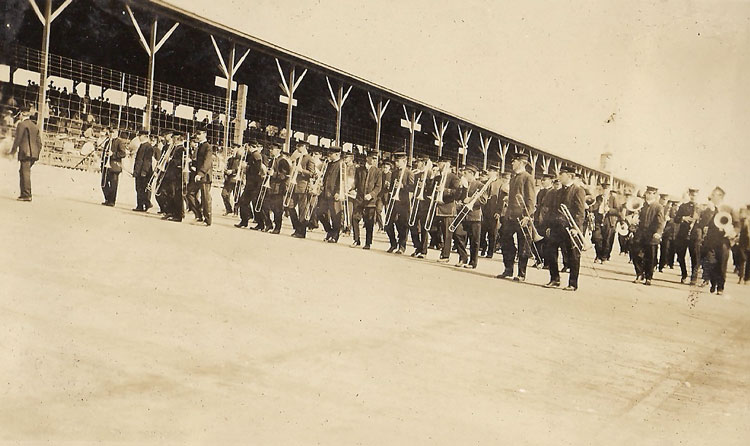
I thought this was a fun photo, since I had mentioned the marching band in a previous post, and it appealed to the little kid in me. I've always loved listening to a brass band at a parade, and I can imagine Ivan running out there to snap a photo with his camera, although he was actually more like 20. I don't have a clue what he used, but I do have a couple of his cameras as part of the collection. It was actually a bit of an ordeal, not like snapping a digital photo with your cell by a long shot. So this shot would have had quite a bit of planning before releasing the shutter. Unfortunately, they all stopped playing just as they got to his position.
Ivan wasn't really careful about the order he put photos in, so I'm not going to try and guess the series of events, but the upcoming photo of the drivers did come after the band. I thought it built a good sense of tension in the scrapbook, so I included it here.
Now it starts to get more interesting. The cars are on the track and we get to walk down and see them in their starting order, sort of. For whatever reason, there are only 4 photos of the grid. It's possible that the photos just didn't come out, but we start with starting position 4, 5, and 6.
I had a major shift in my understanding of the time frame of Ivan's life tonight. I had been working on the incorrect belief that he was much younger when he started flying. I thought he was around 19, when it turns out he was more like 22. This actually answers some perplexing questions I had regarding his military service. I only mention this to point out that it's fun going through this material, and being able to reconstruct facts about a person's life that were misunderstood previously. I'm excited to dig into the collection more as a result.
There are a number of outstanding photos in the next batch coming up. I have a couple of wrecks, breakdowns, and more track-side photos of racers and cars. I also wanted to mention that I'm not doing any photo retouching at all, so far. There may be some that I need to mess with the exposure, just so they're view-able, and I have done a number of photos that I have reprinted with really good results that I hope to frame, soon.
-kpw
As I started digitizing what I felt were interesting photographs, I began to realize that this race may take more than one or two posts. There are just some great photos here, and a lot of interesting stories to go with them! So let's start off with a little fanfare.
![]() |
| Hopefully, we all have the theme from Rocky and Bullwinkle playing in our heads. |
I thought this was a fun photo, since I had mentioned the marching band in a previous post, and it appealed to the little kid in me. I've always loved listening to a brass band at a parade, and I can imagine Ivan running out there to snap a photo with his camera, although he was actually more like 20. I don't have a clue what he used, but I do have a couple of his cameras as part of the collection. It was actually a bit of an ordeal, not like snapping a digital photo with your cell by a long shot. So this shot would have had quite a bit of planning before releasing the shutter. Unfortunately, they all stopped playing just as they got to his position.
Ivan wasn't really careful about the order he put photos in, so I'm not going to try and guess the series of events, but the upcoming photo of the drivers did come after the band. I thought it built a good sense of tension in the scrapbook, so I included it here.
Now it starts to get more interesting. The cars are on the track and we get to walk down and see them in their starting order, sort of. For whatever reason, there are only 4 photos of the grid. It's possible that the photos just didn't come out, but we start with starting position 4, 5, and 6.
![]() |
| Mulford-23, Carlson-25, Chandler-38 |
![]() |
| Positions 9-12. Bragg-21, Duray-14, Guyot-10, and Knipper-31 |
I promised in my goofy pre-post to this race that we'd see a famous WWI aviator in this round of photos, and here's our ace. Eddie Rickenbacker, (from Stephen Sherman's great site) who changed his name from Reichenbacher, so Americans wouldn't confuse him with one of the German aces. My son and I have read his autobiography a number of times and loved it. This was one fascinating man, and I really love the parallels, however few, between him and Ivan. I promise to post a couple of great photos of Rickenbacker at the 1915 race.
![]() |
| Positions 22-26. Burman-17, Rickenbacker-42, Disbrow-1, Wishart-19, Grant-27 |
![]() |
| Positions 13-17. Mason-13, Cooper-2, Thomas-16, Anderson-24 and Dawson-26 |
For this post, I'll leave with this final photo of the pace car and the start of the 1914 Indianapolis 500. Notice the driver and the observer looking back over their shoulder's to get a good look at the start.
I had a major shift in my understanding of the time frame of Ivan's life tonight. I had been working on the incorrect belief that he was much younger when he started flying. I thought he was around 19, when it turns out he was more like 22. This actually answers some perplexing questions I had regarding his military service. I only mention this to point out that it's fun going through this material, and being able to reconstruct facts about a person's life that were misunderstood previously. I'm excited to dig into the collection more as a result.
There are a number of outstanding photos in the next batch coming up. I have a couple of wrecks, breakdowns, and more track-side photos of racers and cars. I also wanted to mention that I'm not doing any photo retouching at all, so far. There may be some that I need to mess with the exposure, just so they're view-able, and I have done a number of photos that I have reprinted with really good results that I hope to frame, soon.
-kpw
9/23/2011
1913 Continued...
I learned something interesting today. I'm allergic to my grandfather's scrapbooks! Last night while I was scanning, I had a couple of little sneeze attacks, but today, I'm pretty well overcome by sneezing every time I handle any of this material. Is it a dust allergy? I don't know but I'm going to be buying more Claritin if this keeps up. Or wearing a dust mask.
So, more of 1913 before we move on to 1914. I didn't have as much time to go digging today, but at least we'll have some interesting photographs. I'm also still fussing around with the layout of the blog. I'm sorry if this is annoying, I just want to get to a format that is easy to read and a bit more interesting. I figured a photo instead of a scrapbook cover would be a better hook for someone visiting the blog for the first time. Let me know what you think. I'd like to see more color, but I'm still fussing.
The more I studied the scrapbook today, the less I think the photos I posted previously were from qualifying. In the other two years (1914, 15 coming up) I'm pretty sure I have photos of the starting grid, the drivers all lined up on the start/finish line, bands playing, etc. Not so with 1913, for some reason, so I'm assuming these are live racing photos.
An acquaintance of mine (actually I'm going to call him a friend) wrote me a very encouraging email about the blog today. I call him a friend because he's been extraordinarily kind and open about a project that he has going on, and he's actually the reason I started the blog. His name is Brian Karli and he's building a Curtiss Jenny just like my grandfather flew. Some of you may be following this since we worked together at Cessna. I think you'd really enjoy a visit to his blog here.
Well, he asked me to post every photo and every journal entry! It would take me (he'll laugh at me, since he's been at his project for six years) years to complete this project if I include everything. As it is, I expect this will actually take me at least a couple of years, but I don't plan on making this a career. Some of the photos are just not interesting enough to post, quite honestly. Some of them are of family members or friends, and I have no clue who they are. Do you really want to see grandma Cora's begonias? Seriously, I have some.
Okay, enough blabbing, here are some more of Indy 500 from 1913. Many of the race photos themselves are of tiny, indistinguishable cars off in the distance. These had some photographic merit, I thought.
This is going to have to do for tonight. 1) I can't stop sneezing, and 2) I spent nearly an hour trying to discover the identity of mystery driver! I'm usually pretty lucky with a jersey, a guy standing next to a car, or a photo that I can ID from the list of entrants. I just struck out on this guy.
I need to mention one last thing about the photo with the star over driver's head. My grandfather followed up in his scrapbooks throughout the years, and would put a star above anyone in his photos who had died. Sadly, you'll see this a LOT when we get to the photos of flying. That was really deadly.
-kpw
So, more of 1913 before we move on to 1914. I didn't have as much time to go digging today, but at least we'll have some interesting photographs. I'm also still fussing around with the layout of the blog. I'm sorry if this is annoying, I just want to get to a format that is easy to read and a bit more interesting. I figured a photo instead of a scrapbook cover would be a better hook for someone visiting the blog for the first time. Let me know what you think. I'd like to see more color, but I'm still fussing.
The more I studied the scrapbook today, the less I think the photos I posted previously were from qualifying. In the other two years (1914, 15 coming up) I'm pretty sure I have photos of the starting grid, the drivers all lined up on the start/finish line, bands playing, etc. Not so with 1913, for some reason, so I'm assuming these are live racing photos.
An acquaintance of mine (actually I'm going to call him a friend) wrote me a very encouraging email about the blog today. I call him a friend because he's been extraordinarily kind and open about a project that he has going on, and he's actually the reason I started the blog. His name is Brian Karli and he's building a Curtiss Jenny just like my grandfather flew. Some of you may be following this since we worked together at Cessna. I think you'd really enjoy a visit to his blog here.
Well, he asked me to post every photo and every journal entry! It would take me (he'll laugh at me, since he's been at his project for six years) years to complete this project if I include everything. As it is, I expect this will actually take me at least a couple of years, but I don't plan on making this a career. Some of the photos are just not interesting enough to post, quite honestly. Some of them are of family members or friends, and I have no clue who they are. Do you really want to see grandma Cora's begonias? Seriously, I have some.
Okay, enough blabbing, here are some more of Indy 500 from 1913. Many of the race photos themselves are of tiny, indistinguishable cars off in the distance. These had some photographic merit, I thought.
![]() |
| The race is on! |
![]() |
| If these fellas seem a little close, it's because they're brothers - Bill and Harry Endicott. Joe Nikrent behind them. |
![]() |
| Mystery driver. Help me out if you can. |
I need to mention one last thing about the photo with the star over driver's head. My grandfather followed up in his scrapbooks throughout the years, and would put a star above anyone in his photos who had died. Sadly, you'll see this a LOT when we get to the photos of flying. That was really deadly.
-kpw
Subscribe to:
Posts (Atom)


